
How to Fix Cracks in Concrete: Methods, Materials and Repair Techniques
Cracking is one of the most common defects encountered in reinforced concrete structures. From minor shrinkage cracks in residential driveways to structural cracking in suspended slabs, beams and walls, understanding the cause of a crack is essential before selecting an appropriate repair method.
Not all concrete cracks require the same treatment. Some cracks are primarily a durability concern, allowing moisture and contaminants to penetrate the concrete, while others may indicate structural movement or a loss of load-carrying capacity. Depending on the circumstances, repairs may involve flexible crack sealants, epoxy resins, cementitious repair mortars or mechanical reinforcement systems such as crack stitching.
In this article, we'll explain how to fix cracks in concrete, the most common repair methods used by remedial contractors and how to determine which approach is appropriate for an existing concrete structure.
Why Does Concrete Crack?
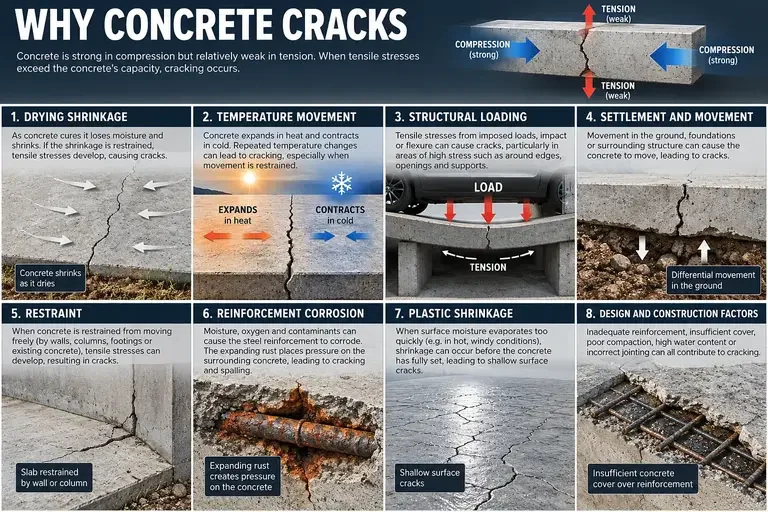
Concrete is strong in compression but relatively weak in tension. When tensile stresses exceed the concrete's capacity, cracking occurs. These stresses can develop for numerous reasons, including drying shrinkage, thermal expansion and contraction, structural loading, settlement, restraint and reinforcement corrosion.
Some cracking is expected during the service life of a concrete structure and does not necessarily indicate a structural defect. However, even non-structural cracks can compromise durability by providing pathways for moisture, oxygen, chlorides and other contaminants to penetrate the concrete.
This is particularly important in reinforced concrete, where increased exposure to moisture and aggressive contaminants can accelerate reinforcement corrosion, eventually leading to concrete delamination and spalling.
Before undertaking repairs, it is important to establish whether the crack is dormant or active. A dormant crack is one that is no longer experiencing significant movement, while an active crack continues to open, close or move as a result of loading, temperature changes or structural movement. This distinction plays a major role in selecting a suitable repair system.
Semi-Rigid Polyurea Crack Sealing
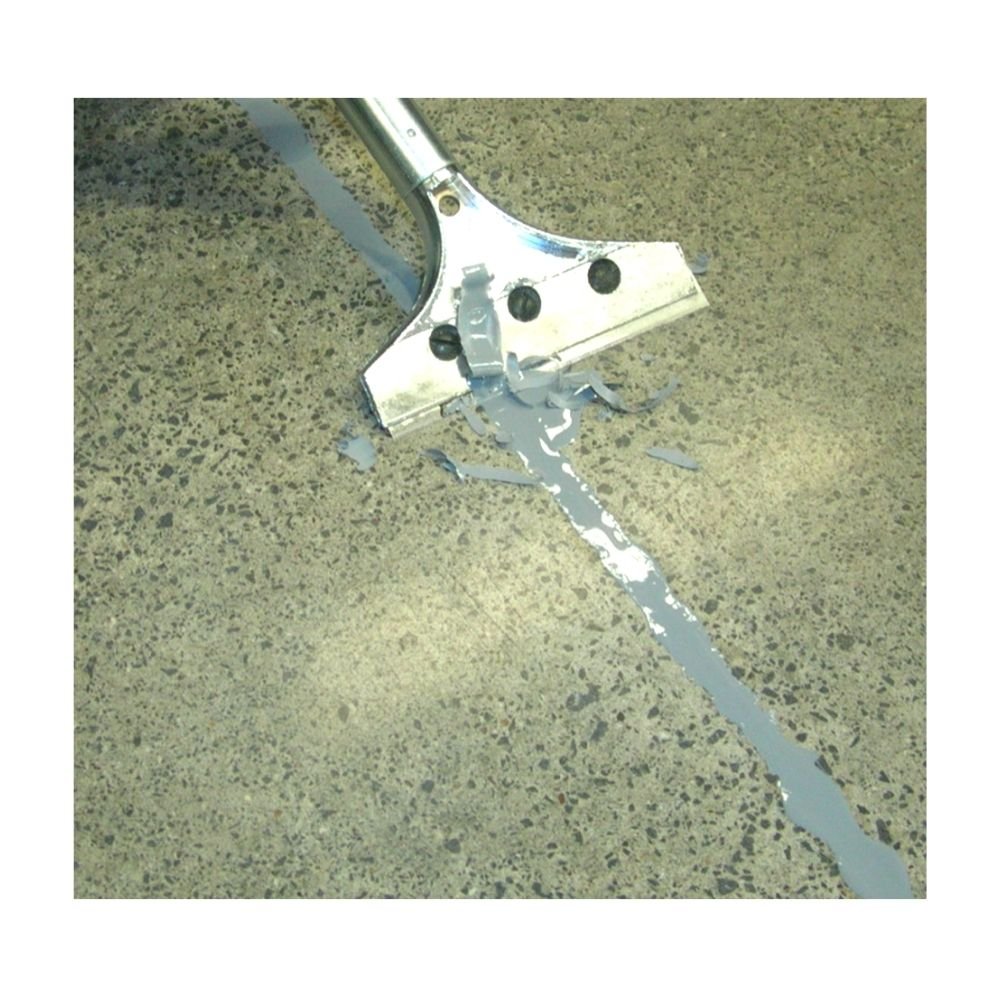
Semi-rigid polyurea is commonly used to seal non-structural cracks in concrete floors and slabs-on-ground, particularly where the objective is to prevent moisture, dirt and other contaminants from entering the crack.
Unlike rigid epoxy systems, semi-rigid polyurea can accommodate limited movement while providing a durable seal within the prepared crack. These products are particularly useful in industrial floors, warehouses, garages and other concrete surfaces exposed to regular foot or vehicle traffic.
The repair typically involves mechanically preparing the crack to create a clean, consistent reservoir before applying the polyurea sealant. Once cured, the material can generally be trimmed flush with the surrounding concrete to provide a smooth surface.
The primary purpose of this method is sealing and protecting the crack rather than restoring structural continuity. Although semi-rigid polyurea can tolerate limited movement, it is not a substitute for a flexible movement joint and may not be suitable where significant ongoing displacement is expected.
High-Viscosity Epoxy Paste and Repair Mortars
High-viscosity epoxy pastes and cementitious repair mortars are commonly used where cracks are relatively wide, irregular or associated with localised surface deterioration.
Unlike low-viscosity injection resins, these materials are designed to remain in place without flowing freely into the crack. They are particularly suitable for filling prepared surface cracks, reinstating damaged edges and repairing localised concrete defects.
Epoxy paste provides a strong, rigid bond and is often selected where a durable adhesive repair is required. Cementitious repair mortars may be more appropriate where larger sections of concrete require reinstatement or where compatibility with the surrounding concrete is important.
For successful repairs, the crack or damaged area must be adequately prepared to remove loose material, contaminants and unsound concrete. Depending on the product and application, the repair may require saw-cut boundaries, mechanical preparation or a bonding agent to achieve satisfactory adhesion.
It is important to recognise that surface filling does not necessarily repair the full depth of a crack. Where a structural bond is required throughout the concrete section, epoxy injection or an engineered mechanical strengthening method may be more appropriate.
Low-Viscosity Epoxy Crack Injection
Low-viscosity epoxy is one of the most widely used methods for repairing dormant structural cracks in reinforced concrete. Unlike surface-applied repair mortars, low-viscosity epoxy resins are designed to penetrate into narrow cracks and bond the opposing concrete faces together. When correctly specified and installed, the epoxy can restore structural continuity across the crack and transfer tensile and shear forces through the repaired section.
There are two common methods of introducing epoxy into a concrete crack.
Gravity-Fed Epoxy Repairs
Gravity-fed epoxy is generally used for horizontal cracks in concrete slabs where the upper surface is accessible.
A low-viscosity epoxy resin is applied along the crack and allowed to penetrate under gravity. Additional resin may be introduced as the material travels deeper into the concrete.
This method is commonly used for dormant cracks in slabs-on-ground, suspended concrete floors and other horizontal surfaces. Its effectiveness depends on the crack width, depth, cleanliness and ability of the resin to penetrate the available voids.
Although gravity feeding is relatively straightforward, complete penetration through the full depth of a crack cannot always be achieved or verified. For this reason, it is generally more suitable where the required repair depth and structural performance can be achieved without pressure injection.
Pressure Injection Epoxy Repairs
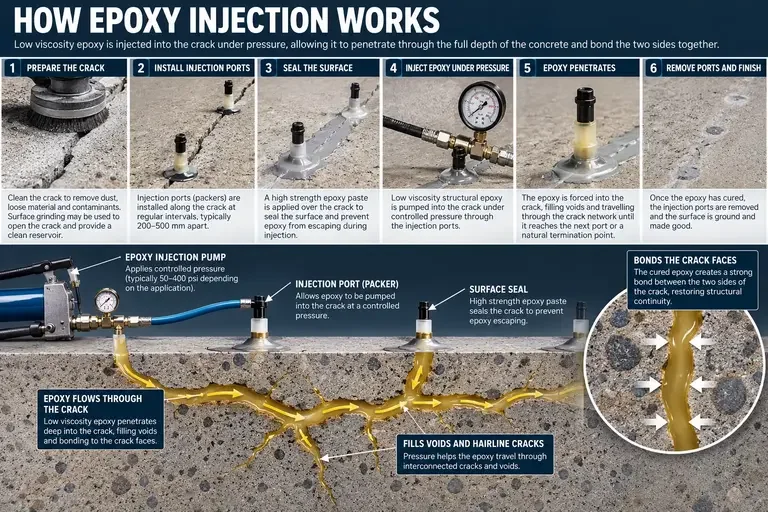
Pressure injection is used where greater control over resin penetration is required, particularly for vertical cracks, overhead repairs and structural elements such as beams, columns and walls.
Injection ports are installed along the crack, and the exposed surface is typically sealed to prevent resin escaping during injection. Low-viscosity structural epoxy is then introduced through the ports under controlled pressure, allowing the resin to travel through the internal crack network.
The objective is to achieve sufficient penetration and bonding throughout the affected section, rather than simply sealing the visible surface.
Epoxy injection can be an effective structural repair method for dormant cracks, provided the concrete is sound and the underlying cause of cracking has been addressed. However, because cured structural epoxy is relatively rigid, it is generally unsuitable for cracks experiencing ongoing movement unless that movement has first been resolved.
Crack Lock Stitching and Mechanical Crack Reinforcement
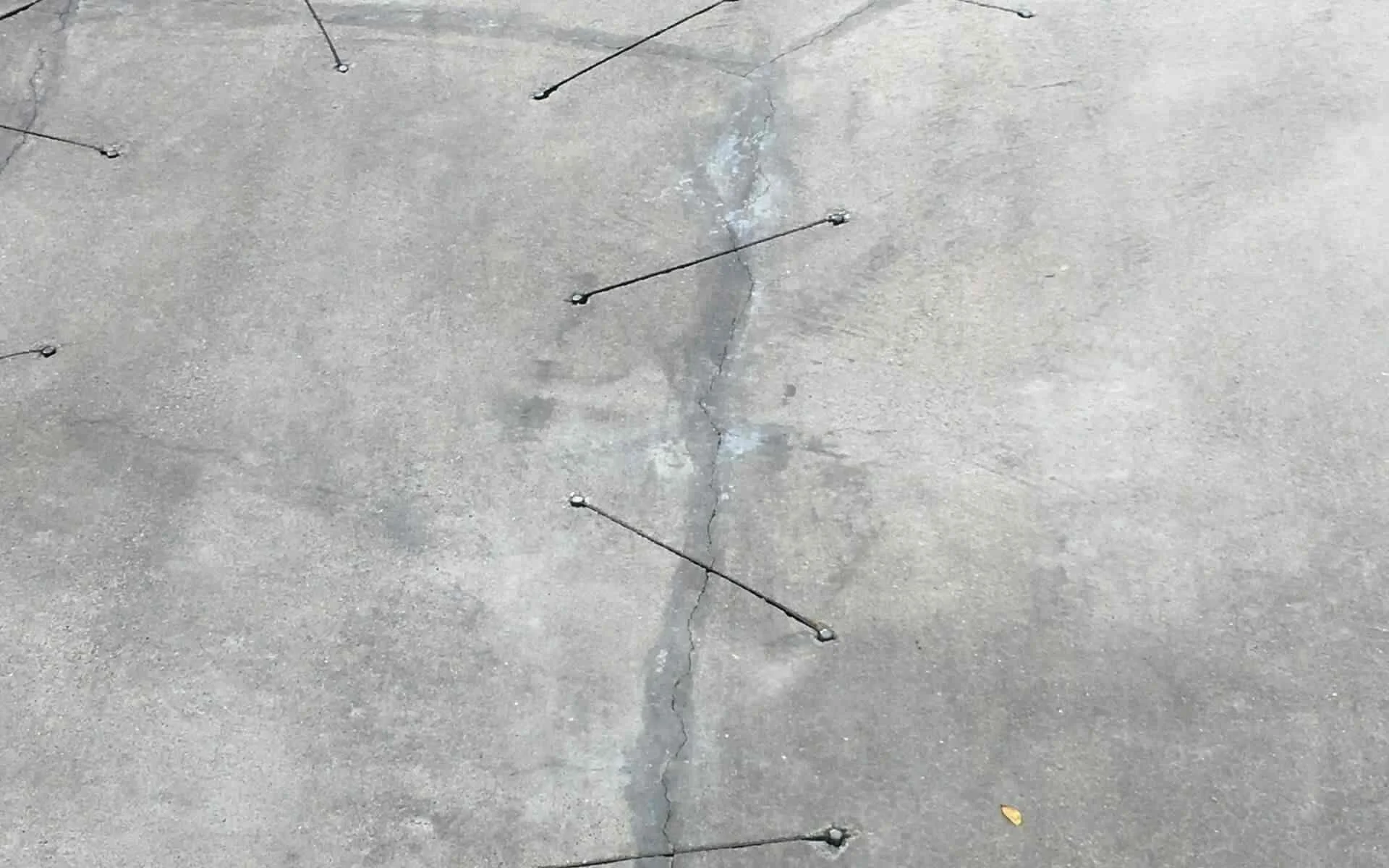
For certain structural cracks, epoxy bonding alone may not provide the most appropriate repair solution. In these situations, engineers may specify crack stitching systems to introduce a mechanical reinforcement element across the crack. Crack Lock stitching involves installing specially designed metal reinforcement connectors into prepared slots that cross the crack. The connectors are bonded into the concrete using an appropriate structural adhesive, creating a mechanical connection between the two sides of the damaged section. Unlike epoxy injection alone, which relies on adhesion between the opposing concrete faces, crack stitching introduces a reinforcing element capable of transferring forces across the crack.
This can be particularly useful where additional tensile resistance is required or where the repair design calls for mechanical reinforcement to supplement the chemical bond provided by epoxy. Crack stitching may be used in conjunction with epoxy injection, allowing the injection resin to bond the internal crack while the stitching system provides additional reinforcement across the affected area.
However, crack stitching is not suitable for every crack. The number, spacing, orientation and type of connectors must be selected according to the structural requirements, and stitching should not be used to restrain movement that the structure needs to accommodate.
Choosing the Right Concrete Crack Repair Method
Selecting the correct repair system depends on several factors, including the cause of cracking, whether movement is ongoing, the width and depth of the crack, environmental exposure and whether structural strength needs to be restored.
Repair methodPrimary applicationSemi-rigid polyureaSealing non-structural floor cracks against contaminants and limited movementHigh-viscosity epoxy pasteRigid surface repairs and filling prepared cracksCementitious repair mortarReinstating wider cracks and damaged concrete sectionsGravity-fed epoxyBonding accessible dormant cracks in horizontal concrete surfacesPressure-injected epoxyStructural bonding of dormant cracks in slabs, beams, walls and other concrete elementsCrack Lock stitchingProviding supplementary mechanical reinforcement across selected structural cracks
In many cases, a combination of repair methods may provide the most effective solution. For example, a dormant structural crack may be pressure injected with epoxy and supplemented with mechanical stitching where required by the engineering design.
Conversely, a non-structural shrinkage crack in a concrete floor may only require sealing with semi-rigid polyurea to prevent contamination and protect the slab from further deterioration.
Why Identifying the Cause of Cracking Matters
One of the most common reasons concrete crack repairs fail is that the repair method addresses the visible crack without resolving the underlying cause. For example, injecting a crack with rigid epoxy may successfully bond the concrete together, but if the slab continues to experience settlement or movement, new cracking may develop adjacent to the repair. Similarly, filling a crack caused by reinforcement corrosion will not prevent further deterioration if the corroding steel and surrounding contaminated concrete are left untreated. Effective concrete crack remediation therefore begins with identifying the deterioration mechanism and determining whether the crack is structural, non-structural, dormant or active.
Not sure what type of crack you’re dealing with? Check our out article here
Can Concrete Cracks Be Repaired Permanently?
Many concrete cracks can be repaired successfully for the remaining service life of the structure, provided the cause has been correctly identified and the repair method is appropriate.
Dormant cracks can often be structurally bonded using epoxy injection, while non-structural cracks can be sealed to reduce the penetration of moisture and contaminants. Where additional reinforcement is required, mechanical crack stitching may provide a more comprehensive repair solution. However, no crack repair system can guarantee that new cracking will never occur. Concrete remains subject to loading, temperature changes, shrinkage and movement throughout its service life.
The objective of a successful repair is therefore to restore the required structural performance or durability of the concrete while minimising the likelihood of future deterioration.
Specialist Concrete Crack Repairs in Sydney
Concrete crack repairs require more than simply filling a visible gap. Selecting the correct treatment involves understanding the cause of cracking, the condition of the surrounding concrete and the performance requirements of the structure.
At TruBond Concrete Repairs, we provide specialist concrete crack repair services throughout Sydney, including epoxy crack injection, semi-rigid polyurea sealing, structural crack stitching and cementitious concrete repairs. Our work covers residential, commercial and industrial structures, including slabs-on-ground, suspended slabs, beams, walls and other reinforced concrete elements.
Whether you're dealing with shrinkage cracking in a concrete floor or structural cracks requiring engineered remediation, TruBond can assess the affected areas and recommend a repair methodology suited to the condition of the concrete and the intended performance of the structure.