
Concrete cancer is a common problem affecting reinforced concrete buildings throughout Sydney, particularly older apartment buildings, balconies, staircases and structures exposed to coastal environments. Once reinforcement corrosion begins, the resulting expansion can cause concrete to crack, delaminate and eventually spall, leaving the embedded steel vulnerable to further deterioration.
One of the first questions property owners and strata managers ask is: How much does concrete cancer repair cost?
In Sydney, minor localised repairs may cost a few thousand dollars, while extensive structural remediation involving reinforcement replacement, scaffolding and concrete reconstruction can cost tens or even hundreds of thousands of dollars. The cost depends on considerably more than the visible size of the damaged area. The extent of concealed deterioration, condition of the reinforcement, accessibility and required repair methodology all influence the final price.
Understanding these factors can help property owners, builders and strata committees budget appropriately and avoid selecting inadequate repairs based solely on the lowest quotation.
How Much Does Concrete Cancer Repair Cost in Sydney?
Concrete cancer repair costs vary significantly depending on the severity and location of the deterioration. While some contractors provide square-metre rates, these can be misleading because two similarly sized repairs may require entirely different levels of preparation, reinforcement treatment and structural reinstatement.
The following figures provide a general indication of potential repair costs for projects in Sydney.
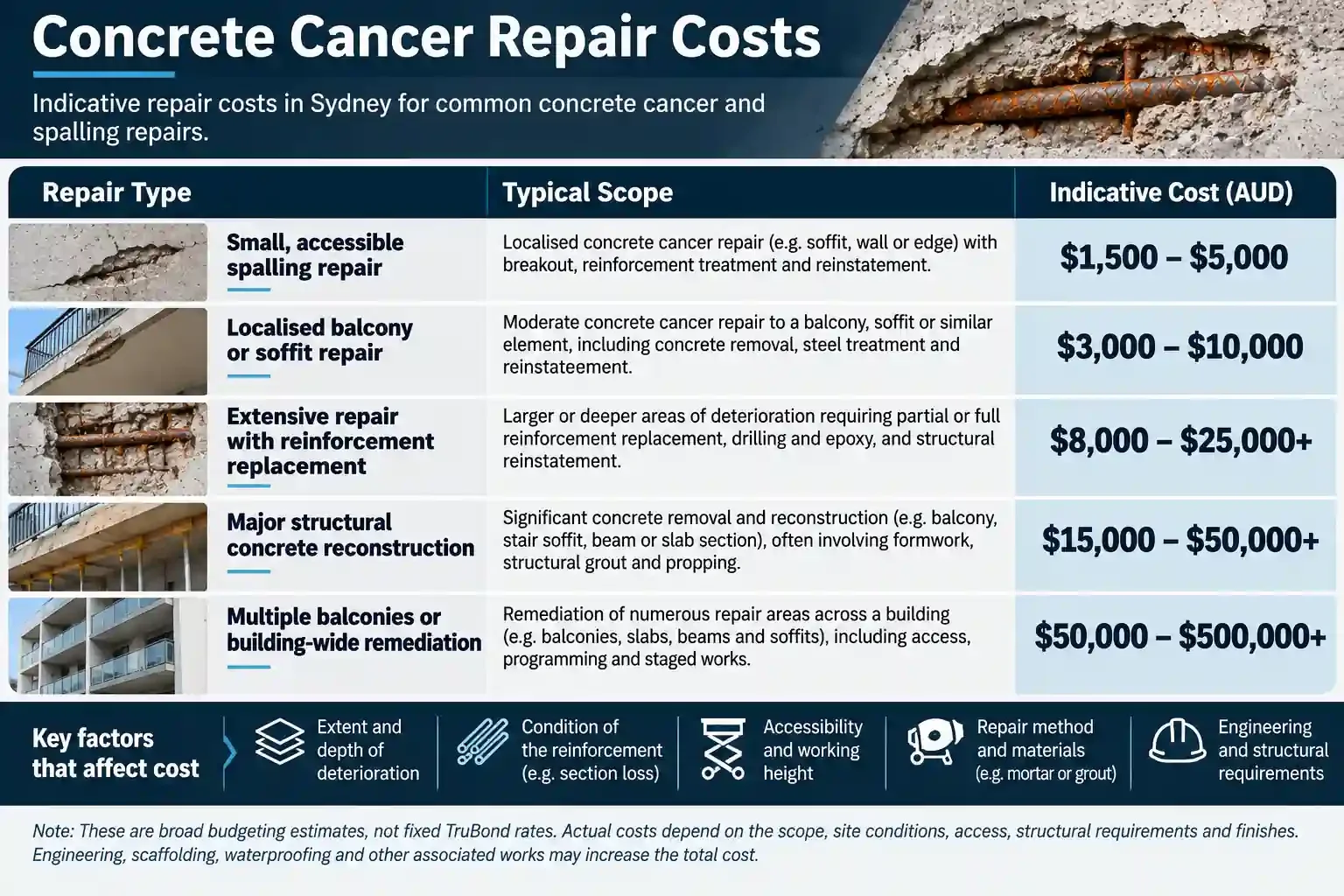
For small isolated repairs, the minimum cost of mobilising equipment, preparing the concrete and completing the work can represent a substantial proportion of the total price. Larger projects may achieve better economies of scale, particularly where multiple repair areas can be completed during the same mobilisation.
What Factors Affect Concrete Cancer Repair Costs?
1. Extent and Depth of Concrete Deterioration
The visible area of spalling does not always represent the full extent of the problem. Concrete surrounding a damaged section may already be delaminated or affected by reinforcement corrosion, despite appearing relatively sound from the surface.
During preparation, contractors may discover that considerably more concrete needs to be removed than initially anticipated. This increases demolition, waste disposal, reinforcement preparation and repair material quantities.
The depth of deterioration is equally important. A shallow repair requiring 20–30 mm of reinstatement will generally involve less material and labour than a deep structural repair requiring extensive breakout around multiple layers of reinforcement or multiple layers of repair mortar buildup.
2. Condition of the Reinforcement
The condition of the embedded steel is one of the most significant factors affecting repair costs. Where corrosion is superficial and the reinforcement retains sufficient cross-sectional area, treatment may involve mechanical cleaning, corrosion protection and reinstatement with a suitable repair mortar.
However, advanced corrosion can cause substantial reinforcement section loss, requiring additional steel to be installed or existing bars to be replaced. These repairs are considerably more complex because they may require structural engineering, drilling and chemical anchoring, reinforcement laps, temporary propping and additional concrete demolition. In severe cases, the cost of restoring the reinforcement and structural capacity can exceed the cost of the concrete reinstatement itself.
3. Accessibility and Working Height
Access requirements can significantly influence the cost of concrete cancer repairs, particularly on multi-storey apartment buildings and commercial structures. Ground-level repairs are generally more economical than repairs to elevated balcony soffits, building façades or structural elements requiring specialist access equipment. Depending on the location, contractors may require scaffolding, elevated work platforms, rope access or temporary exclusion zones.
Overhead repairs can also be more labour-intensive because demolition, reinforcement preparation and mortar application must be undertaken against gravity, increasing time and labour demand. For strata buildings with multiple affected balconies, coordinating access across several levels can become a major component of the overall remediation budget.
4. Repair Method and Materials
The selected repair methodology also affects pricing.
Minor localised spalling may be reinstated using hand-applied polymer-modified repair mortars. Widespread or deeper structural repairs may require mobilisation of high velocity mortar sprayers to improve material compaction around bars and overall site efficiency.
In areas where extensive quantities of concrete has been removed and access allows it, form and pour repairs can be particularly effective where substantial sections of concrete need to be reinstated while maintaining the original dimensions and profile.
Additional treatments such as galvanic anodes, corrosion inhibitors, waterproofing systems and anti-carbonation coatings may also be incorporated to improve long-term durability. Although these measures increase the initial cost, they may help reduce the likelihood of further deterioration and future maintenance expenditure.
5. Engineering and Structural Requirements
Not all concrete cancer repairs are purely cosmetic.
Where deterioration affects structural elements such as suspended slabs, beams, columns, balconies or staircases, engineering assessment may be necessary to determine the extent of reinforcement loss and establish an appropriate repair methodology. Depending on the project, additional requirements may include structural drawings, temporary propping designs, reinforcement replacement details, inspections and quality assurance documentation.
These requirements increase the initial project cost but are important where the deterioration has affected the structural performance of the concrete.
Why Small Concrete Cancer Repairs Can Be Expensive
A common misconception is that repairing a small area of concrete spalling should be inexpensive because only a limited quantity of material is required. In reality, the repair mortar or grout may represent only a small proportion of the total project cost.
Even a relatively small repair can require site establishment, dust containment, concrete demolition, reinforcement cleaning, corrosion treatment, substrate preparation, material mixing, application, curing and final clean-up. Specialist concrete repair materials also need to be installed in accordance with the manufacturer's requirements, which may involve multiple stages and return visits.
For this reason, the cost of repairing a small isolated patch cannot always be calculated accurately using a simple square-metre rate.
Is It Cheaper to Repair Concrete Cancer or Replace the Concrete?
In many situations, repairing concrete cancer is considerably more economical than demolishing and replacing an entire structural element. Where deterioration is localised and the surrounding concrete remains structurally sound, targeted remediation can preserve most of the existing structure while addressing the damaged sections.
For example, repairing isolated areas of concrete cancer beneath a balcony may avoid the substantial costs associated with demolishing and reconstructing the entire balcony slab. However, where corrosion is widespread, reinforcement loss is extensive or the remaining concrete is structurally inadequate, partial or complete reconstruction may become the more practical option.
The decision should consider not only the initial repair cost but also the expected service life, future maintenance requirements and likelihood of additional deterioration developing elsewhere in the structure.
Can Concrete Cancer Return After Repairs?
Yes. Concrete cancer can return if the underlying deterioration mechanisms are not adequately addressed.
One common problem is the incipient anode effect, also known as the halo effect. This can occur when deteriorated concrete is replaced with fresh repair material while the surrounding original concrete remains contaminated with chlorides or affected by carbonation.
The difference in electrochemical conditions can contribute to corrosion becoming concentrated around the perimeter of the repair, eventually causing new cracking and spalling. For structures exposed to aggressive coastal environments, additional corrosion protection measures may be appropriate. These can include galvanic anodes, protective coatings and other engineered corrosion mitigation systems.
While these treatments increase the initial repair cost, they can improve the long-term durability of the structure and reduce the risk of repeated repairs.
Why Early Concrete Cancer Repairs Are More Cost-Effective
Concrete cancer is a progressive deterioration mechanism. Once reinforcement corrosion begins, continued exposure to moisture and contaminants can cause further steel section loss and damage to the surrounding concrete.
A repair that initially requires only localised breakout and reinforcement treatment may eventually develop into a much larger project involving extensive demolition, reinforcement replacement and structural reconstruction.
Early identification and remediation can therefore reduce both the extent of the required works and the associated costs.
For strata buildings and commercial properties, regular inspections and planned maintenance can also help distribute repair expenditure over time rather than allowing deterioration to develop into a major unplanned remediation project.
How to Get an Accurate Concrete Cancer Repair Quote
The most reliable way to determine the cost of concrete cancer repairs is through an inspection of the affected structure. During an assessment, a specialist contractor will consider the visible deterioration, accessibility, likely extent of concealed damage, reinforcement condition and suitable repair methodology.
For larger projects, concrete sounding surveys, reinforcement scanning, chloride testing or engineering investigations may be required to establish the full extent of deterioration before a detailed scope can be prepared. Property owners should also ensure quotations clearly identify what is included, particularly regarding concrete breakout, reinforcement treatment, structural repairs, access equipment, surface finishes and protective coatings.
Comparing quotations solely on price can be misleading where different contractors have allowed for substantially different repair methodologies.
Concrete Cancer Repair Specialists in Sydney
At TruBond Concrete Repairs, we provide specialist concrete cancer and spalling repairs throughout Sydney and the Central Coast. Our work includes balcony soffit repairs, suspended slabs, staircases, beams, columns and other reinforced concrete structures affected by reinforcement corrosion.
We undertake targeted concrete remediation using methods such as reinforcement corrosion treatment, structural grout reinstatement, form-and-pour repairs and protective coating systems. Where required, we work alongside structural engineers to implement repair methodologies suited to the condition and structural requirements of the affected concrete.
Whether you require a small localised spalling repair or more extensive structural concrete remediation, TruBond can assess the affected areas and provide a quotation based on the actual scope of work.
Contact TruBond Concrete Repairs to arrange an assessment and discuss the cost of repairing concrete cancer at your property.